Geomembranes and geotextiles from India · Project and farm supply
Geomembranes and Geotextiles from India - Liners, Fabrics and Agricultural Films
Geomembranes and geotextiles from India line landfills, mining ponds, canals, reservoirs and farm ponds, and separate, filter and reinforce soil in roads and embankments. This hub covers the eight products Newton Exports supplies most for contractors, mines, farms and distributors, from HDPE geomembrane and needle punched geotextile to mulch, greenhouse and silage films.
Each section explains the thicknesses, weights, standards and roll sizes buyers specify, with an indicative HS code and an approximate 20 ft container load. Share your project specification or crop use, and we will match the right product and roll size.
At a glance
Geosynthetics: HDPE and LLDPE geomembrane, woven and non-woven geotextile
Agri films: Pond liners, mulch film, greenhouse film, silage film
Thickness: Liners 0.3 to 3.0 mm; films 20 to 200 micron
Standards: GRI GM13, GM17, ASTM test methods, IS 15351
Rolls: Widths up to about 8 m; lengths to order
Shipment: FOB, CFR or CIF from Mundra, Nhava Sheva, Chennai
HS headings: 3920 (plastic sheets), 5603 and 5407 (geotextiles)
India as a geosynthetics and agricultural film supplier
India has a large plastics and technical textiles industry, and geosynthetics and agricultural films are a fast-growing part of it. Manufacturers in Gujarat, Maharashtra, Tamil Nadu and Delhi NCR run blown film and flat die lines for geomembranes and films, and needle punching and weaving lines for geotextiles. The government's push for technical textiles and big infrastructure, irrigation and mining projects has built capacity and testing know-how at home.
Indian geomembranes are made to the Geosynthetic Research Institute (GRI) GM13 standard for HDPE and GM17 for LLDPE, which international engineers commonly specify, and are tested by ASTM methods. Agricultural films are made with UV stabilisers and additives for Indian and tropical sun, which suits buyers in Africa, the Middle East and South-East Asia. Many producers also offer installation guidance and welding equipment for liners.
For an accurate quote, buyers should share the application, the required thickness or weight, the standard or specification, roll width and length, colour and the total area. Newton Exports sources from certified manufacturers, checks test certificates for each lot and plans container loading by roll size and weight.
HDPE geomembrane liners
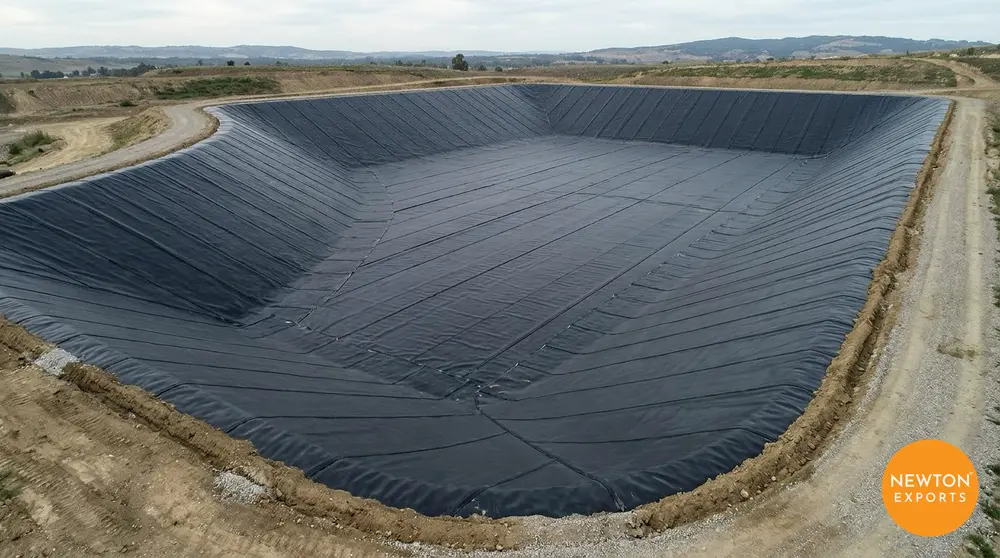
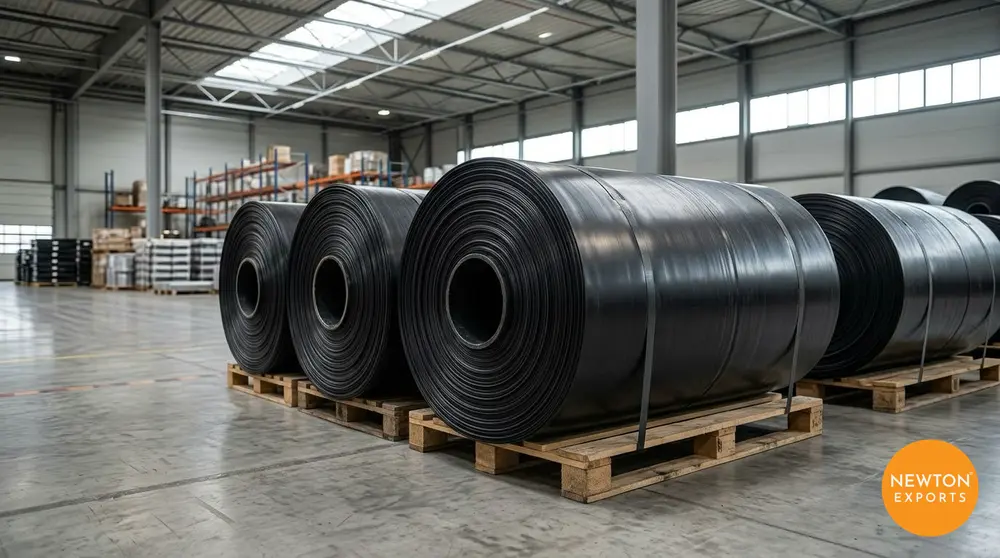
HDPE (high density polyethylene) geomembrane is the most widely used liner for landfills, mining heap leach pads, tailings ponds, effluent lagoons, canals and water reservoirs. It is strong, has excellent chemical resistance and a long service life when buried or covered. Indian manufacturers make smooth and textured HDPE geomembrane from 0.5 mm to 3.0 mm thick, in black, white-black and other colours.
Specifications follow GRI GM13, which sets minimum values for density, tensile strength, tear and puncture resistance, carbon black content, oxidative induction time and UV resistance. Textured sheets give better friction on slopes. Rolls are typically 5.8 to 8 metres wide and up to a few hundred metres long, depending on thickness. Each roll is labelled with its number, and test certificates are provided for each production lot.
Key grades and specs: 0.5 to 3.0 mm; smooth and textured; GRI GM13; black, white-black
HS code (indicative): 39201019 (indicative) | 20 ft load: Approx. 18 to 24 MT; 40 ft often used for wide rolls
LLDPE geomembrane liners
LLDPE (linear low density polyethylene) geomembrane is more flexible than HDPE and can stretch more before it fails, so it follows uneven ground and settlement better. It is used for pond covers, secondary containment, canal linings, landfill caps and agricultural reservoirs where flexibility matters more than maximum chemical resistance.
LLDPE geomembrane is made in thicknesses from about 0.3 mm to 2.0 mm, in smooth and textured finishes, and is specified to GRI GM17. Buyers state the thickness, colour, roll size and required properties such as tensile elongation and puncture resistance. Rolls are supplied with test certificates, and installation by hot wedge or extrusion welding is the same as for HDPE.
Key grades and specs: 0.3 to 2.0 mm; smooth and textured; GRI GM17
HS code (indicative): 39201019 (indicative) | 20 ft load: Approx. 18 to 24 MT; 40 ft often used for wide rolls
Non-woven geotextile
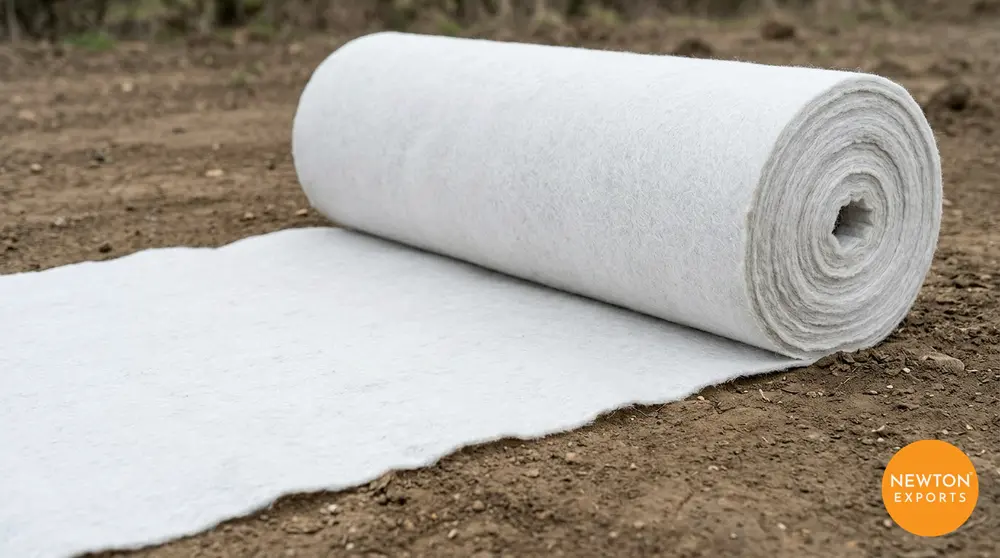
Non-woven geotextile is a felt-like fabric made by needle punching polypropylene or polyester fibres. It is used for separation between soil layers, filtration in drains, protection of geomembranes from puncture, and erosion control under riprap. Indian producers make staple fibre and continuous filament non-woven geotextiles from about 100 gsm to 1,200 gsm.
Buyers specify the mass per unit area (gsm), the polymer, and key properties such as grab tensile strength, CBR puncture resistance, apparent opening size and permeability. Heavier grades are used as cushion layers over liners, and lighter grades for drainage and separation. Rolls are typically 4 to 6 metres wide, wrapped in UV-protective film and labelled with grade and roll number.
Key grades and specs: 100 to 1,200 gsm; PP or PET; staple fibre and continuous filament
HS code (indicative): 56039400 (by weight, indicative) | 20 ft load: Approx. 8 to 14 MT, 28 CBM (volume limited)
Woven geotextile
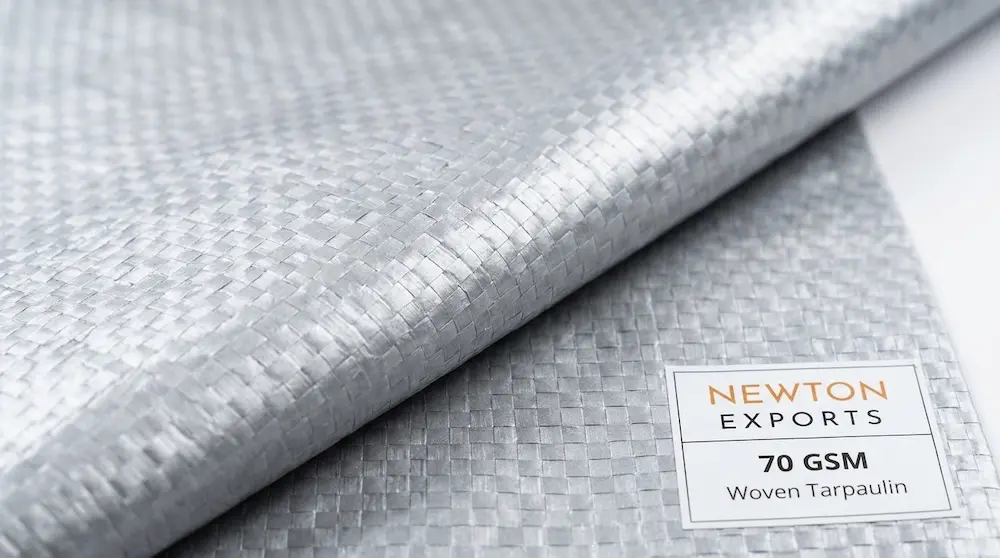
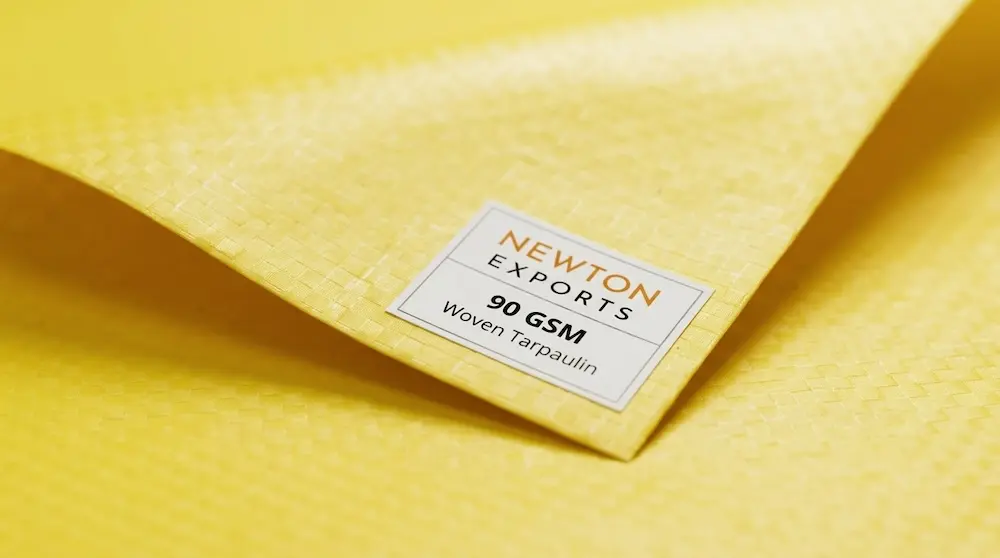
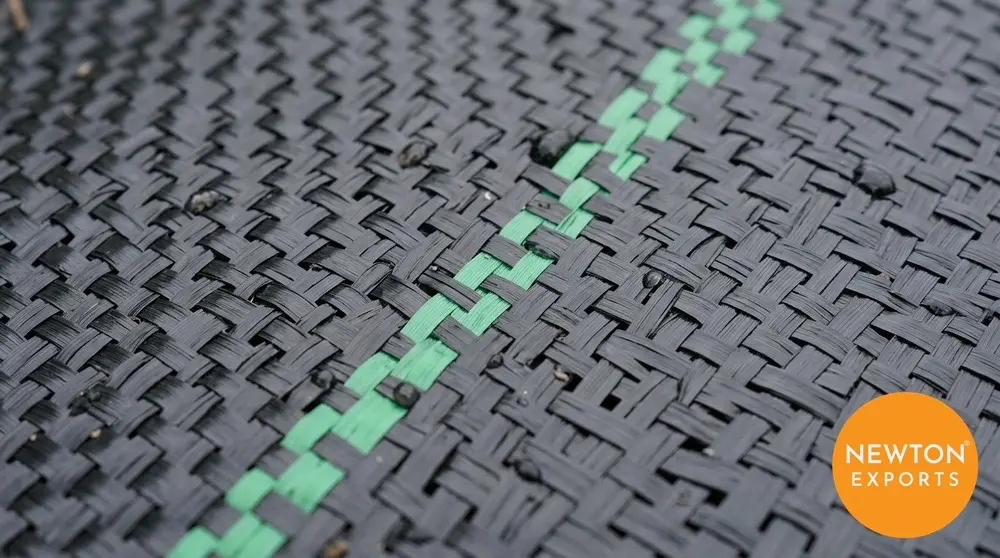
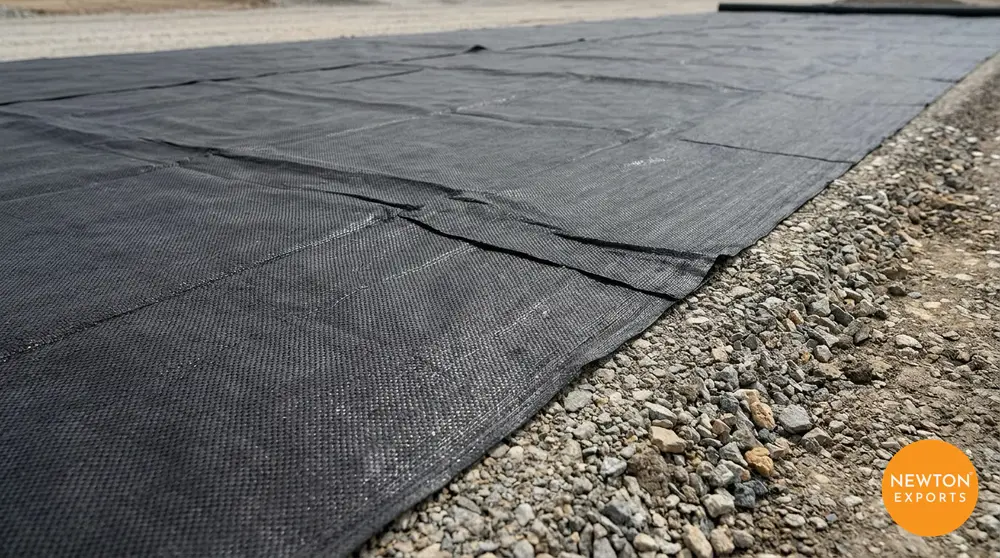
Woven geotextile is made by weaving polypropylene tapes or multifilament yarns into a strong, stable fabric. It is used mainly for soil stabilisation and reinforcement under roads, rail beds and embankments, for separation over soft ground, and in silt fences and erosion control. It has high tensile strength and low elongation compared with non-woven fabrics.
Woven geotextiles are specified by tensile strength in kN per metre, elongation, apparent opening size and UV resistance, with strengths from about 20 kN/m to over 100 kN/m. Rolls are usually 4 to 5.25 metres wide and 100 to 200 metres long. Fabrics are UV stabilised, and test certificates confirm the properties for each lot.
Key grades and specs: 20 to 100+ kN/m; PP tape and multifilament; UV stabilised
HS code (indicative): 54072090 (indicative) | 20 ft load: Approx. 14 to 18 MT, 28 CBM
Buying more than one of these products? Ask for a mixed-container quote.
Pond liners
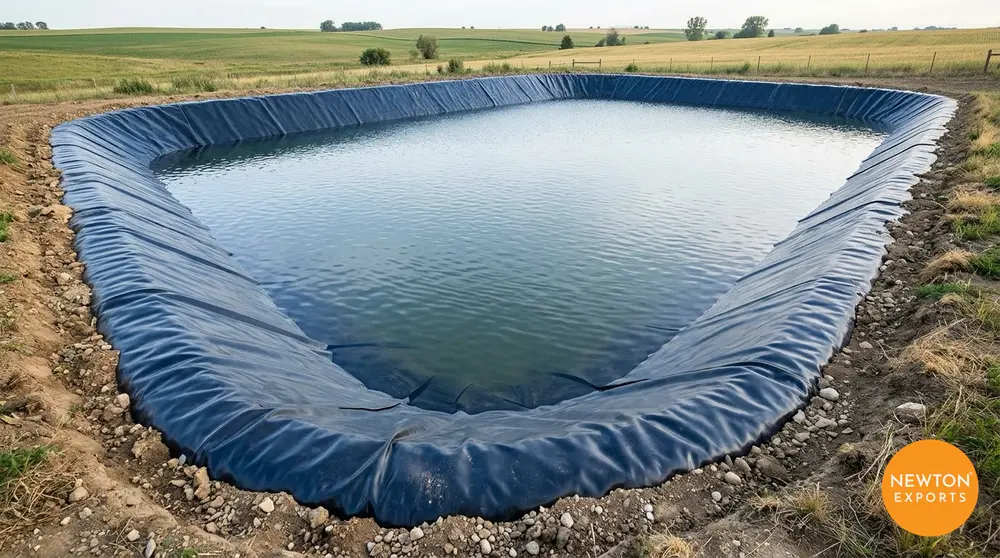
Pond liners keep water in farm ponds, fish and shrimp ponds, irrigation tanks, biogas digesters and decorative ponds. India supplies them in HDPE, LLDPE and reinforced woven HDPE or LDPE laminated films, from about 200 micron to 1.5 mm. Fabricated liners can be welded to the exact pond size at the factory, which reduces site work for farmers and contractors.
Aquaculture buyers often prefer HDPE liners with UV stabilisers and food-safe materials, while farmers on a budget use reinforced laminated liners. Buyers specify the material, thickness, colour and either roll size or the finished pond dimensions. Liners are folded or rolled, packed in bags or with wrapping, and labelled with size and thickness.
Key grades and specs: HDPE, LLDPE, reinforced laminated; 200 micron to 1.5 mm; fabricated to size
HS code (indicative): 39201099 (indicative) | 20 ft load: Approx. 16 to 22 MT, by thickness
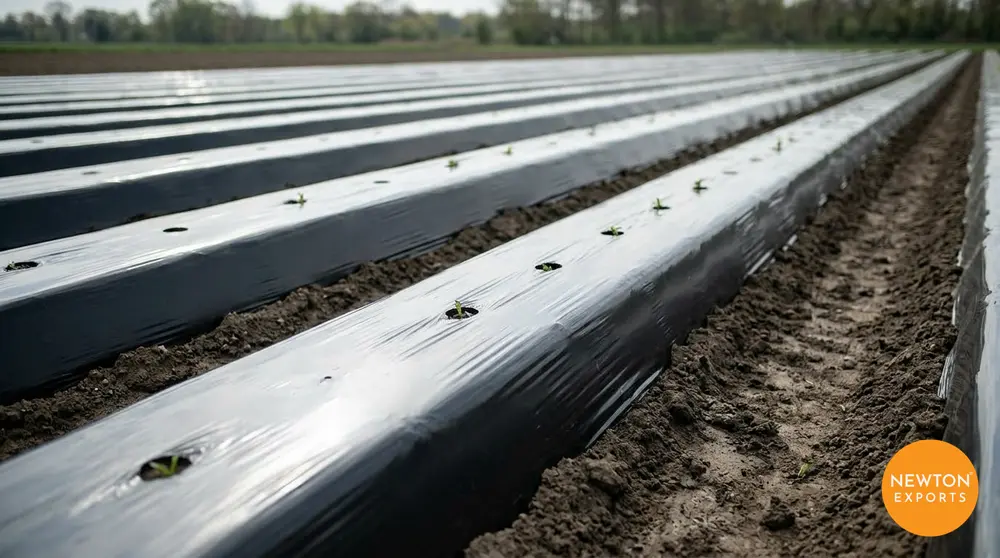
Agricultural mulch film
Mulch film is laid over crop beds to suppress weeds, save water, control soil temperature and keep fruit clean. India makes black, silver-black, white-black and coloured LLDPE mulch films from about 20 to 50 micron, with pre-punched planting holes on request. Biodegradable mulch films are also available for buyers who want to reduce plastic waste.
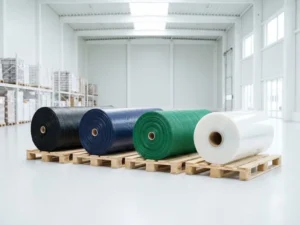
Buyers specify the colour combination, thickness, width (usually 0.9 to 1.5 metres), roll length and any hole pattern. UV stabilisation is matched to the crop duration. Films are wound on cores in rolls of a set length, packed with labels and loaded on pallets or loose in the container. Silver-black films are popular in hot climates because they reflect heat and deter some insects.
Key grades and specs: 20 to 50 micron; black, silver-black, white-black; punched option; biodegradable
HS code (indicative): 39201099 (indicative) | 20 ft load: Approx. 16 to 20 MT, 28 CBM
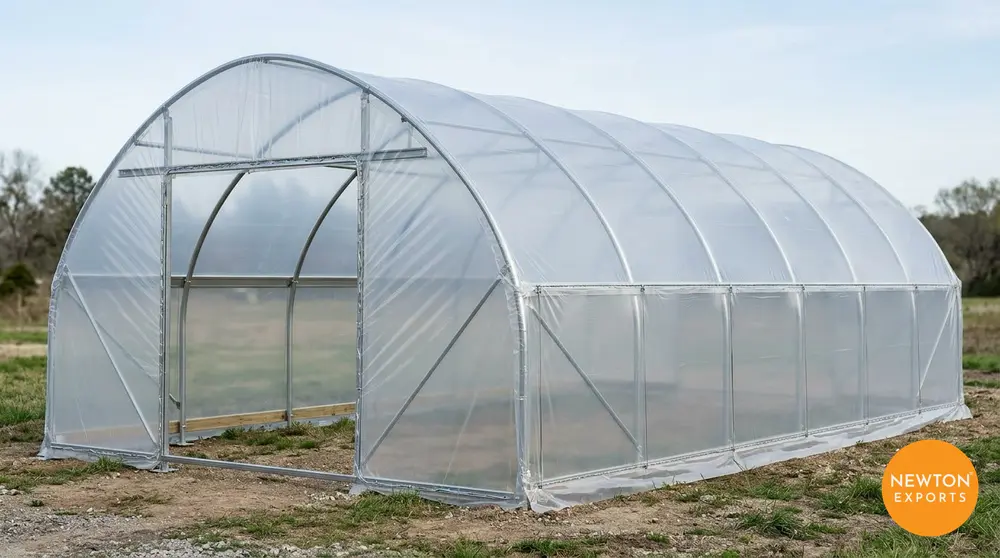
Greenhouse and polyhouse film
Greenhouse film covers polyhouses, tunnels and net houses used for vegetables, flowers and nursery plants. Indian manufacturers make multi-layer LDPE and LLDPE films from about 100 to 200 micron with UV stabilisers for several seasons of use, and add properties such as anti-drip, anti-fog, light diffusion, IR heat retention and anti-dust.
Buyers specify the thickness, width (often up to about 9 to 12 metres folded), length, UV life in months or seasons, light transmission and special additives. The film type is chosen for the local climate and crop. Rolls are wrapped in black film to protect them from light before installation and are labelled with the outer side marked so they are fitted correctly.
Key grades and specs: 100 to 200 micron; 3 or 5 layer; UV, anti-drip, diffused, IR; 1 to 4 seasons
HS code (indicative): 39201012 (indicative) | 20 ft load: Approx. 16 to 20 MT, 28 CBM
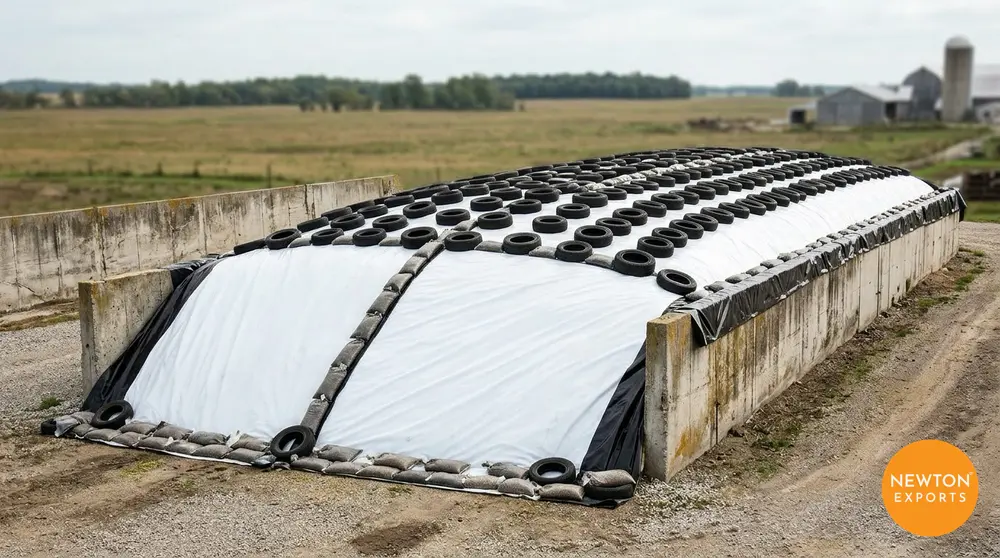
Silage film and bags
Silage film is used to cover silage pits and bunkers, and silage bags and wrap film are used to store fermented fodder for dairy cattle. Good silage needs airtight storage to ferment properly, and the film blocks oxygen and light. India makes black-white silage covers from about 100 to 200 micron, oxygen barrier films, and silage bags for small and medium dairy farms.
Buyers specify the size, thickness, colour and UV life. White outer layers reflect sunlight and keep the silage cooler, while the black inner layer blocks light. Silage bags are supplied in sizes from about 50 kg to 1,000 kg capacity. Films and bags are packed in rolls or bundles in cartons and are increasingly bought by dairy cooperatives and farm suppliers in Africa and Asia.
Key grades and specs: 100 to 200 micron; black-white; oxygen barrier; covers and bags
HS code (indicative): 39201099 (indicative) | 20 ft load: Approx. 16 to 20 MT, 28 CBM
Geomembranes, geotextiles and agricultural films compared
Typical export specifications. Final grade, packing and HS code are confirmed in the specification sheet for each order.
Product
Key grades and specs
Typical packing
HS code
HDPE Geomembrane
0.5 to 3.0 mm; smooth and textured; GRI GM13; black, white-black
Rolls on cores with slings, labelled by roll number
39201019 (indicative)
LLDPE Geomembrane
0.3 to 2.0 mm; smooth and textured; GRI GM17
Rolls on cores with slings
39201019 (indicative)
Non-Woven Geotextile
100 to 1,200 gsm; PP or PET; staple fibre and continuous filament
Rolls wrapped in UV film
56039400 (by weight, indicative)
Woven Geotextile
20 to 100+ kN/m; PP tape and multifilament; UV stabilised
Rolls wrapped in PP or film
54072090 (indicative)
Pond Liners
HDPE, LLDPE, reinforced laminated; 200 micron to 1.5 mm; fabricated to size
Folded or rolled in bags or wrap
39201099 (indicative)
Mulch Film
20 to 50 micron; black, silver-black, white-black; punched option; biodegradable
Rolls on cores, labelled, palletised
39201099 (indicative)
Greenhouse Film
100 to 200 micron; 3 or 5 layer; UV, anti-drip, diffused, IR; 1 to 4 seasons
Rolls wrapped in black protective film
39201012 (indicative)
Silage Film
100 to 200 micron; black-white; oxygen barrier; covers and bags
Rolls or bundles in cartons
39201099 (indicative)
Send your product list, grades and destination port for an FOB, CFR or CIF offer.
Container loading
Approximate figures. Thick geomembranes reach the weight limit quickly, while light geotextiles fill a container by volume. Wide liner rolls often need 40 ft containers. Confirm roll sizes and the packing list before quoting.
Approx. 8 to 24 MT
Approx. net weight per 20 ft container, depending on product
Approx. 28 CBM (20 ft)
Approx. usable volume per 20 ft container
HDPE Geomembrane
Approx. 18 to 24 MT; 40 ft often used for wide rolls
LLDPE Geomembrane
Approx. 18 to 24 MT; 40 ft often used for wide rolls
Non-Woven Geotextile
Approx. 8 to 14 MT, 28 CBM (volume limited)
Woven Geotextile
Approx. 14 to 18 MT, 28 CBM
Pond Liners
Approx. 16 to 22 MT, by thickness
Mulch Film
Approx. 16 to 20 MT, 28 CBM
Greenhouse Film
Approx. 16 to 20 MT, 28 CBM
Silage Film
Approx. 16 to 20 MT, 28 CBM
Quality checks before shipment
Thickness and weight
Thickness of liners and films and mass per area of geotextiles are measured across the roll width.
Mechanical tests
Tensile, tear, puncture and elongation tests are done to ASTM or IS methods for each production lot.
UV and additives
Carbon black content, OIT, UV stabiliser and special film additives are checked against the specification.
Roll labelling
Each roll is labelled with grade, size and roll number, wrapped for protection and matched to test certificates.
Request a quote for geomembranes and geotextiles from India
Send the product, thickness or weight, specification, roll size and total area, plus the destination port. We reply with pricing, test data and a lead time.
Prefer email? Send your requirement to mail@newtonexports.com
Request a QuoteFAQs
Geomembranes and geotextiles from India FAQs
Which geomembranes and geotextiles from India do you supply?
We supply HDPE and LLDPE geomembranes in smooth and textured finishes, non-woven needle punched geotextiles, woven geotextiles, pond liners, and agricultural films such as mulch, greenhouse and silage films. These products are used in landfills, mining, water storage, roads and embankments, aquaculture and farming. Each product is sourced from manufacturers that specialise in that line and provide test certificates for every lot.
What is the difference between HDPE and LLDPE geomembrane?
HDPE geomembrane is stiffer and has higher strength and chemical resistance, so it is the usual choice for landfills, mining leach pads and chemical containment. LLDPE geomembrane is more flexible and can stretch more, which helps it follow uneven ground and resist stress cracking where there is settlement, so it is often used for caps, covers and reservoirs. The right choice depends on the chemicals, ground conditions and exposure, and your designer's specification should decide.
What does GRI GM13 mean?
GRI GM13 is a widely used specification published by the Geosynthetic Institute that sets minimum property values and test methods for HDPE geomembranes, such as density, thickness, tensile strength, tear and puncture resistance, carbon black content and long-term durability tests. Many engineers and tenders require compliance with GM13 for HDPE and GM17 for LLDPE. We supply products with test certificates showing results against these specifications.
How do I choose the right geotextile weight?
The right geotextile depends on its job. For separation and filtration in drains and roads, lighter non-woven geotextiles of around 150 to 300 gsm are common. For cushioning and protecting a geomembrane from stones, heavier grades of 400 to 1,200 gsm are used. For reinforcement on soft ground, woven geotextiles with high tensile strength are better. Your project specification usually sets the required properties, and we can match a suitable grade.
Can pond liners be fabricated to the size of my pond?
Yes, many pond liners can be fabricated at the factory to the exact length and width of your pond, including the slopes and anchor trench, so they arrive ready to lay with few or no joints on site. Please share the top and bottom dimensions and depth of the pond, along with the preferred material and thickness. For large ponds, liners are supplied in rolls and welded on site with hot wedge welding machines.
How long do agricultural films last in the field?
The life of a film depends on its thickness, UV stabilisation and the local climate. Mulch films are usually designed for one crop season. Greenhouse films are made with UV stabilisers for one to four seasons, and buyers can choose the life needed. Strong sun, high temperatures and contact with some agrochemicals can shorten film life. Tell us your location, crop and expected duration, and we will recommend a suitable grade.
Can you supply welding equipment or installation support for liners?
We can source hot wedge and extrusion welding machines and accessories with geomembrane orders, and share installation guidelines from the manufacturer. For large projects, some manufacturers can provide supervision or training for installation crews. Proper installation is essential for liner performance, so we recommend using experienced installers and testing seams with air pressure and vacuum methods.
How are geomembrane rolls loaded in containers?
Geomembrane rolls are heavy and long, so they are loaded with forklifts or cranes using slings fitted to each roll, and placed lengthwise in the container. Roll width decides whether a 20 ft or 40 ft container is needed, and wide rolls of about 7 to 8 metres usually need 40 ft containers. Rolls are secured to prevent movement, and the packing list records each roll number, thickness, width, length and weight.
Specifications, HS codes and container loads are typical and indicative. They are confirmed in the specification sheet and packing list for each order.