

TMT Rebars (IS 1786) vs B500A, B500B and B500C: A Technical Cross-Grade Guide for Global Sourcing
TMT Rebars from India vs B500A, B500B and B500C Grades
For international buyers sourcing TMT rebars from India, comparing B500A, B500B and B500C with Indian grades requires more than looking at the number 500. B500A, B500B and B500C are 500 MPa reinforcement grades defined under BS 4449, with the principal distinction being their tensile-to-yield ratio and ductility. Indian grades such as Fe500 and Fe500D are specified under IS 1786. Individual Indian manufacturers can also offer products whose actual properties are above the minimum IS 1786 requirements, or products developed for higher strength and ductility. This means an Indian TMT product may satisfy a particular overseas specification, but grade names should not be treated as automatic equivalents.
1. B500A, B500B and B500C: what the letters mean
BS 4449:2005+A3:2016 defines three reinforcement grades -B500A, B500B and B500C -with a characteristic yield strength of 500 MPa. The principal difference is ductility and the tensile-to-yield strength ratio (Rm/Re). According to The Concrete Centre’s summary of BS 4449, B500A requires an Rm/Re ratio of at least 1.05 and Agt of at least 2.5%; B500B requires at least 1.08 and 5.0%; and B500C requires at least 1.15 but less than 1.35, with Agt of at least 7.5%.
The Agt value is total elongation at maximum force. It should not be confused with the conventional total elongation reported over a gauge length in Indian product specifications. This difference in test terminology is important when comparing an overseas purchase specification with an Indian mill test certificate.
2. Understanding the British/European Classification: BS 4449:2005
Under BS 4449:2005+A3:2016 (Steel for the reinforcement of concrete – Weldable reinforcing steel), steel TMT rebars share a characteristic yield strength (Re) of 500 MPa. The differentiation lies strictly in plastic deformation capacity and tensile-to-yield ratio (Rm/Re):
- B500A (Class A Ductility): The lowest ductility tier. Requires Rm/Re ge 1.05 and Total Elongation at Maximum Force (Agt) ≥ 2.5%. Mostly used in cold-drawn reinforcement fabrics, wire mesh, and light structural framing where cyclic or seismic loading is negligible.
- B500B (Class B Ductility): The standard specification for cast-in-place reinforced concrete. Requires Rm/Re ≥ 1.08 and A ≥ ge 5.0%.
- B500C (Class C Ductility / Seismic Class): The high-ductility tier engineered for seismic energy dissipation and dynamic loads. Requires Rm/Re to be bounded between ≥ 1.15 and < 1.35, paired with a demanding Agt ≥ 7.5%. The upper bound on tensile ratio ensures that plastic hinges form predictably without brittle concrete failure during earthquake stress reversals.
3. Indian TMT Rebars Fe500 and Fe500D under IS 1786:2008
IS 1786 provides the Indian classification for high-strength deformed TMT steel rebars and wires used for concrete reinforcement. For Fe500, the minimum yield strength is 500 MPa, minimum tensile strength is 545 MPa, the minimum UTS/YS ratio is 1.08 and minimum total elongation is 12%. For Fe500D, the minimum yield strength is 500 MPa, minimum tensile strength is 565 MPa, the minimum UTS/YS ratio is 1.10, total elongation is 16%, and the SAIL specification table also shows a minimum uniform elongation of 5%.
Fe500D therefore has materially higher ductility requirements than standard Fe500. However, the fact that Fe500D and B500B both sit around a 500 MPa yield-strength level does not by itself establish equivalence. The governing standard, test method, chemistry, product form and the complete project specification must be checked.
4. B500 grades vs Indian grades: specification comparison
| Grade | Standard | Yield | Tensile strength | Rm/Re | Elongation / Agt % |
|---|---|---|---|---|---|
| B500A | BS 4449:2005+A3:2016 | 500 MPa | Ratio-based | 1.05* | ≥2.5%* |
| B500B | BS 4449:2005+A3:2016 | 500 MPa | Ratio-based | 1.08 | ≥5.0% |
| B500C | BS 4449:2005+A3:2016 | 500 MPa | Ratio-based | ≥1.15 and <1.35 | ≥7.5% |
| Fe500 | IS 1786:2008 + amendments | 500 MPa | 545 MPa min | ≥1.08 | Elongation 12%; Agt not specified |
| Fe500D | IS 1786:2008 + amendments | 500 MPa | 565 MPa min | ≥1.10 | Elongation 16%; Agt ≥5.0% |
* BS 4449 gives characteristic values. For B500A, the standard specifies 1.02 for the Rm/Re characteristic and 1.0% for Agt for sizes below 8 mm. Do not read the B500A/B/C entries as fixed minimum tensile strengths derived simply by multiplying 500 by the ratio.
Important: this table compares published specification requirements; it is not an equivalence table. Agt and conventional elongation are different measures, so the percentages should not be compared as though they were identical tests.
5. Chemical Composition of TMT Rebars
Commonly published IS 1786 limits for Fe500 are maximum carbon 0.30%, sulphur 0.055%, phosphorus 0.055% and S+P 0.105%. For Fe500D, the corresponding limits are carbon 0.25%, sulphur 0.040%, phosphorus 0.040% and S+P 0.075%. Published IS 1786 product documentation also gives a carbon-equivalent limit of 0.42% for Fe500D.
Grade | C max | S max | P max | S+P max |
Fe500 | 0.30% | 0.055% | 0.055% | 0.105% |
Fe500D | 0.25% | 0.040% | 0.040% | 0.075% |
For B500B/B500C, chemical requirements should be checked against the exact BS 4449 product specification and certification route. Buyers should not mix chemical limits from different editions or standards.
6. Is Fe500D Equivalent to B500B?
Fe500D should not be described as automatically equivalent to B500B. However, the two specifications have some important overlapping mechanical requirements: both use a 500 MPa yield-strength level, and the minimum tensile/yield ratios are 1.10 for Fe500D and 1.08 for B500B. SAIL’s published IS 1786 table also gives 5% minimum uniform elongation for Fe500D.
For a specific project, an Fe500D TMT rebar product may therefore satisfy the mechanical requirements of a B500B specification, but this must be demonstrated against the complete project standard, test method, chemistry, dimensional requirements and certification. Where the purchase order calls for BS 4449 B500B, the safest procurement route is to obtain material certified to that specification or obtain written engineering approval for the proposed Indian grade.
7. Can Fe500D replace B500C?
Not as a general grade conversion. B500C requires an Rm/Re ratio of at least 1.15 and less than 1.35 together with Agt of at least 7.5%. Standard Fe500D specifies a lower minimum UTS/YS ratio of 1.10 and, in the SAIL table, 5% minimum uniform elongation. The published minimum requirements therefore do not establish B500C equivalence.
Some Indian products have higher published performance. For example, Tata Tiscon 550SD specifies a 1.15 minimum UTS/YS ratio and 5.0% elongation at maximum force, while SAIL SeQR Fe550D lists a 1.15 typical UTS/YS ratio. These figures can be relevant to a project-specific technical assessment, but they should not be converted into a blanket statement that Fe550D or 550SD is ‘B500C equivalent’. The project engineer and the governing standard determine acceptability.
8. What About Fe500S?
Fe500S is a separate Indian seismic-oriented grade and should not be presented simply as ‘the Indian equivalent of B500C‘. SAIL’s published IS 1786 Amendment-3 product data gives Fe500S a yield-strength range of 500 to 650 MPa, minimum tensile/yield ratio of 1.25, minimum elongation of 18% and minimum Agt of 8%.
These figures overlap or exceed several B500C ductility characteristics, but the standards remain different. Project-specific acceptance and certification are still required.
9. What international buyers should specify
When sourcing TMT bars from India for an overseas project, avoid specifying only ‘500 grade rebar’. The purchase specification should identify the governing standard and grade, required yield and tensile properties, ductility measure, chemical limits, bar diameter and length, rib requirements, testing and inspection requirements, and the documentation required with shipment.
If the project is designed to BS 4449, specify B500A, B500B or B500C directly. If the project uses IS 1786, specify the required Indian grade. If an alternative Indian grade is proposed, compare the complete manufacturer test certificate with the project specification before approval.
10. What the four Indian manufacturers show
The manufacturer literature supplied for this article shows why actual product data can be significantly better than the minimum grade requirement.
SAIL
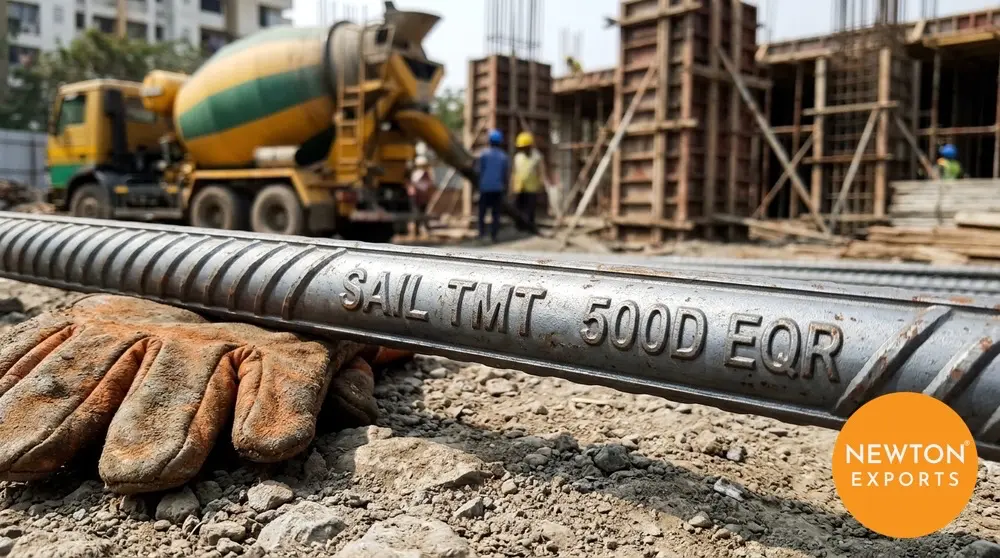
SAIL‘s SeQR product documentation lists the IS 1786 Fe500D reference at 500 MPa yield strength, 565 MPa tensile strength, a minimum UTS/YS ratio of 1.10 and 16% total elongation, with 5% uniform elongation. For SAIL SeQR Fe550D, the published typical values are 550 MPa yield strength, a UTS/YS ratio of 1.15 and 16% total elongation. SAIL also lists BS 4449 B500B among the grades available from its IISCO Steel Plant, demonstrating that an Indian producer can supply to the British specification rather than relying on an assumed grade conversion.
Tata Tiscon
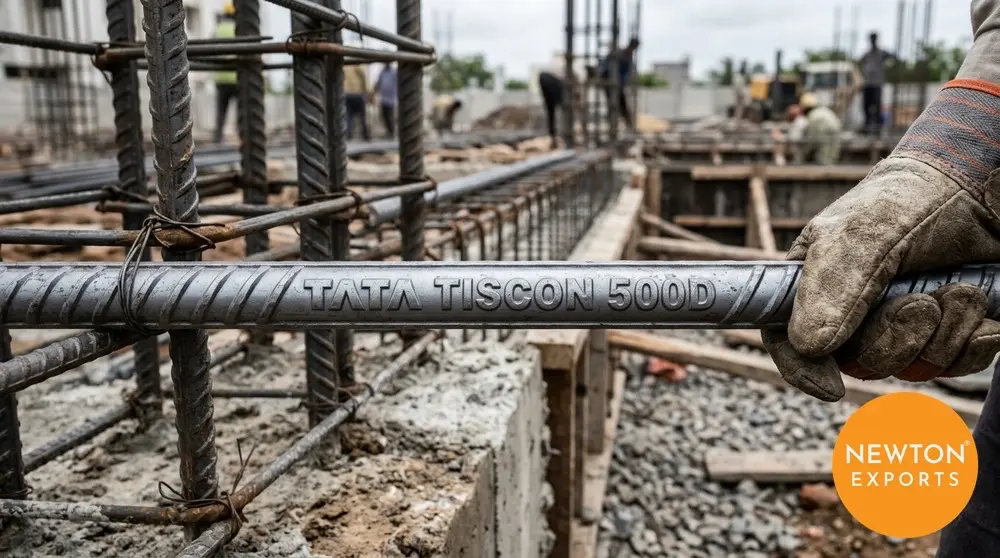
The Tata Tiscon 500D brochure gives a minimum IS 1786 Fe500D yield strength of 500 MPa and shows Tata Tiscon 500D at 540 MPa yield strength, 600 MPa UTS, a 1.32 UTS/YS ratio and 18% elongation. The brochure states that Tata Tiscon 500D is comparable to Indian, American, British and Australian standards, but this manufacturer statement should not be interpreted as a universal grade-equivalence rule.
The Tata Tiscon 550SD brochure gives manufacturer values of 570 MPa minimum yield strength, 660 MPa maximum yield strength, 15% higher UTS than the IS 1786 minimum, a 1.15 minimum UTS/YS ratio, a maximum UTS/YS ratio of 1.25, 16% total elongation and 5.0% total elongation at maximum force. These are product-specific values and are particularly relevant when buyers are investigating higher-ductility reinforcement.
Jindal Panther
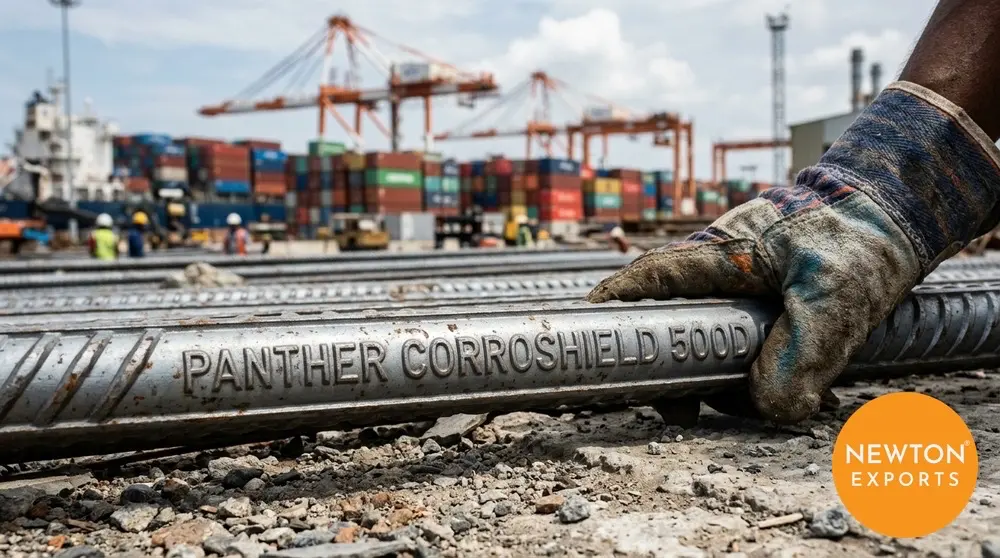
The Jindal Panther Fe550D brochure specifies a minimum yield strength of 550 MPa, minimum ultimate tensile strength of 600 MPa, minimum elongation of 16% and a minimum UTS/YS ratio of 1.10. The brochure also shows higher actual values in its stress-strain illustration, including an actual yield strength of about 575 MPa and elongation of about 21.75%. Jindal Panther’s material therefore illustrates the difference between the minimum grade specification and actual product performance.
JSW Neosteel
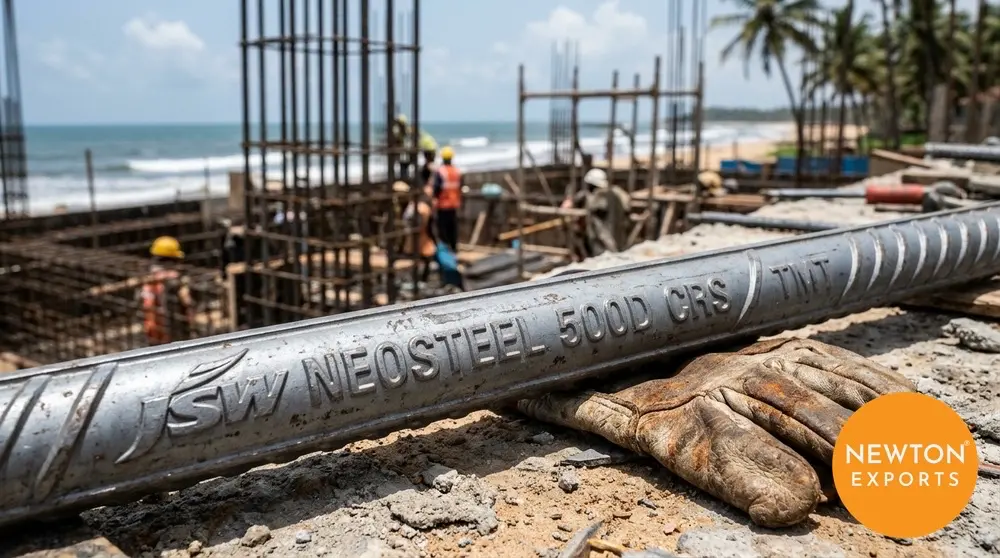
JSW Neosteel‘s technical specification gives Fe500D at 530 MPa minimum yield strength, 610 MPa minimum tensile strength, a minimum UTS/YS ratio of 1.13 and 18% minimum elongation. For Fe550D, the published values are 580 MPa yield strength, 650 MPa tensile strength, a 1.13 minimum ratio and 16% elongation; Fe550D EDS is listed with a 1.15 minimum ratio and 16% elongation. JSW also states that its products can conform to Indian, American, British and Australian standards and can be supplied to specific customer requirements.
11. How Newton Exports can support TMT bar import
Newton Exports can offer TMT reinforcement bars from established Indian producers according to the buyer’s required grade, diameter, quantity, destination and certification requirements. For projects using British or European reinforcement specifications, the key service is not simply finding a 500 MPa bar; it is identifying a product and mill specification that can be documented against the buyer’s engineering requirements.
For each export enquiry, buyers should request the applicable mill test certificate and, where required, third-party inspection or additional testing. This approach allows the buyer, engineer and supplier to establish compliance before shipment rather than relying on a grade-name comparison.
12. Conclusion
B500A, B500B and B500C are 500 MPa reinforcement grades distinguished principally by tensile-to-yield ratio and ductility. Indian Fe500 and Fe500D use the IS 1786 classification, while Indian manufacturers also offer higher-strength and higher-ductility products such as Fe550D and 550SD.
The four manufacturer brochures reviewed for this article show that actual Indian products can exceed the minimum IS 1786 requirements by substantial margins. They also show why international buyers should distinguish between a manufacturer’s actual product performance and the formal equivalence of two standards. For an overseas construction project, the correct approach is to specify the governing standard, compare the complete mechanical and chemical requirements, and verify compliance through the manufacturer’s documentation and project approval.
Technical source basis
- The Concrete Centre – Standards for reinforcement: BS 4449:2005+A3:2016 B500A/B/C characteristic properties.
- SAIL SeQR TMT Bars – published IS 1786 and SAIL product mechanical/chemical properties.
- SAIL IISCO Steel Plant – published product basket including BS 4449 B500B.
- Tata Tiscon 500D product brochure – mechanical and chemical properties.
- Tata Tiscon 550SD product brochure (2026) – mechanical and chemical properties.
- Jindal Panther Fe550D TMT Rebars brochure – mechanical properties and product information.
- JSW Neosteel technical brochure (September 2025) – Fe500D, Fe550D and Fe550D EDS specifications.
Editorial note: Manufacturer claims and product-specific values above are presented as published in the supplied brochures. They should not be interpreted as a certification that any Indian grade is universally interchangeable with a BS 4449 grade. Images are for visual enhancement purposes only.
Start Your BOQ Sourcing India Request
If you’re an EPC contractor, MEP contractor, or a turnkey project manager sourcing materials for a construction project anywhere in the world, special TMT rebars, send us your BOQ – civil, MEP, low-voltage, interiors or any other BOQ. There’s no cost to get a quote, and we work to turn it around quickly so it doesn’t hold up your procurement schedule.