Unbleached Bagasse Tableware: The 2026 Buyer's Guide to PFAS-Free Export from India
The EU's PFAS ban is now in force and more US states are following. Here is how to buy bagasse plates, clamshells and meal trays that pass the new rules and still hold up to hot, oily food.
By Newton Exports · Updated October 2026 · 12 min read
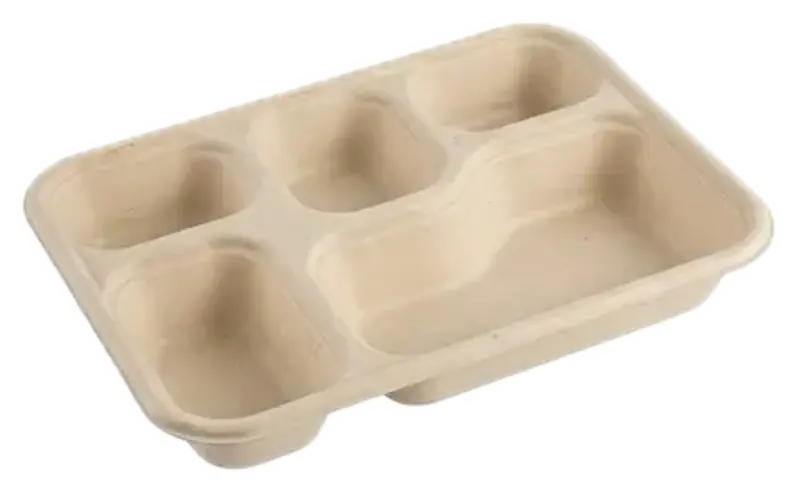
Bagasse tableware is disposable food packaging moulded from sugarcane fibre, the pulp left over once the juice is pressed out. Plates, bowls, clamshells and compartment trays made from it are sturdy, microwave-safe and compostable. Since 12 August 2026 they also need to be provably free of PFAS to be sold in the European Union. That one date has changed more buyer conversations this year than price ever did.
12 Aug 2026
EU PFAS ban for food-contact packaging applies
25 ppb
EU limit for any single targeted PFAS
14
US states with PFAS food-packaging laws
Free
US base duty on HS 4823.70 moulded pulp
What Is Bagasse Tableware?
Sugarcane mills crush cane to extract juice and are left with a mountain of dry fibre called bagasse. Some is burned for energy. The rest can be pulped, poured into heated moulds and pressed into rigid shapes, the same way egg trays are made, but with a much finer, denser finish. The result is a plate or container that handles hot food, goes in the microwave and breaks down in commercial composting.
India is the world's second-largest sugar producer, so the raw material is plentiful, local and cheap. That is a big part of why Indian bagasse mills have grown so quickly, and why buyers who used to source only from China are now running trials with Indian suppliers.
02The 2026 PFAS Rules for Bagasse Tableware, in Plain English
PFAS ("forever chemicals") were the industry's easy fix for grease resistance. A small dose in the pulp stopped curry oil and burger grease soaking through. Regulators have now closed that door.
European Union
Under Article 5 of the PPWR (Regulation (EU) 2025/40), food-contact packaging cannot be placed on the EU market from 12 August 2026 if it contains PFAS at or above any of three limits: 25 ppb for any individual targeted PFAS, 250 ppb for the sum of targeted PFAS, and 50 ppm for total PFAS including polymeric PFAS. There is no grandfathering. Stock made earlier but sold after that date still has to comply. Your technical file needs test data to prove it.
United States
There is no single federal ban yet, but fourteen states have passed laws on PFAS in food packaging, most of them banning "intentionally added" PFAS in plant-fibre packaging. California has been strictest since January 2023, using a 100 ppm total organic fluorine screen. Maine's ban on plant-fibre packaging took effect in May 2026. National chains do not run separate stock for each state, so in practice PFAS-free has become the US standard too.
Watch out
"PFAS-free" printed on a spec sheet is a claim, not evidence. Ask for a third-party lab report (total fluorine and targeted PFAS) that names the exact product and batch.
How PFAS-Free Bagasse Actually Performs
This is the part most suppliers skip, so let us be straightforward. Water resistance in moulded fibre comes mainly from AKD, a sizing agent that is not a PFAS. That is why good PFAS-free bagasse holds hot soup, tea and gravy without trouble. Oil resistance used to come from fluorochemicals, and the PFAS-free alternatives are good but not yet equal at high temperatures. Even the chemical suppliers say the current options are built for low- to mid-temperature use.
"Hot water is easy. Hot oil is the real test. Put your hottest, oiliest dish in the box and wait 30 minutes."
In practice: a PFAS-free clamshell carries a burger, fried rice or a sandwich comfortably. A deep-fried item packed straight from the fryer and left for an hour may show oil marks on the outside. For delivery menus, ask your supplier for hot-water and hot-oil holdout results (temperature and minutes), then run paid samples with your real food before you sign off a container.
Buyer tip
A slightly heavier piece (more grams of fibre) gives you more oil holdout and rigidity than any coating. If a quote is suspiciously cheap, weigh the sample.
Unbleached vs Bleached Bagasse
Unbleached (natural kraft)
Warm beige-brown colour of the natural fibre. Skips the bleaching stage entirely, so less chemistry and less water. Reads as "natural" to customers, hides minor stains, and suits premium, organic and sustainability-led brands.
Bleached (white)
Bright white finish, closer to paper or foam. Bleached with chlorine-free methods by good mills. Preferred where the food presentation needs a white plate, such as weddings, airlines and some catering.
Both perform the same in strength and heat. The choice is about brand image and cost. Our unbleached bagasse tableware range is made without chemical bleaching, without plastic lining and without added PFAS. That is the combination European and North American buyers have asked for most this year.
05The Bagasse Tableware Range
These are the formats food-service buyers order most. Each card opens the product page with sizes and specifications.
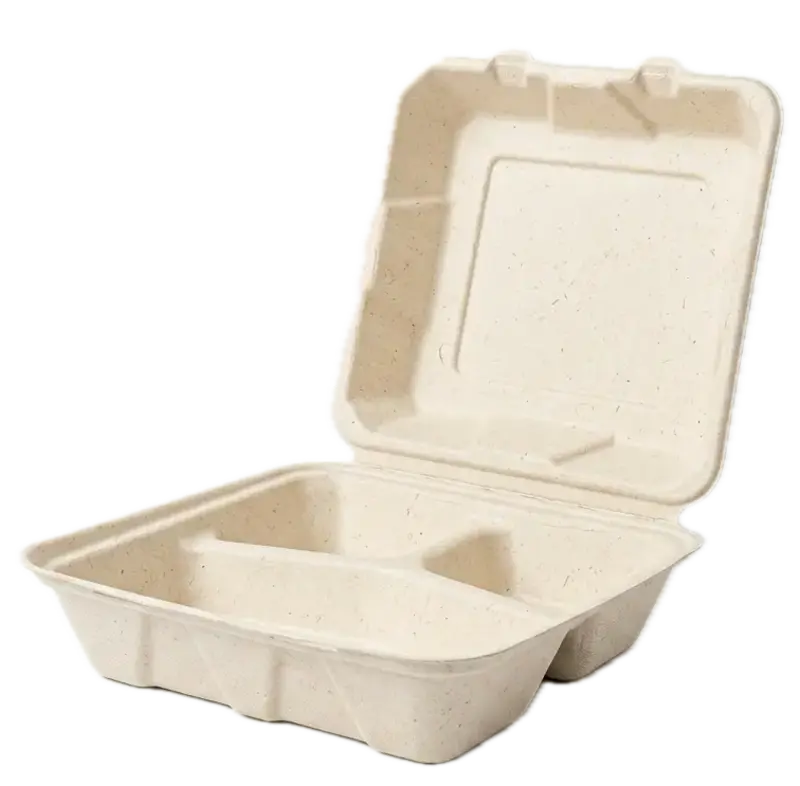 9 x 9 (3CP) Clamshell Full meals, takeaway
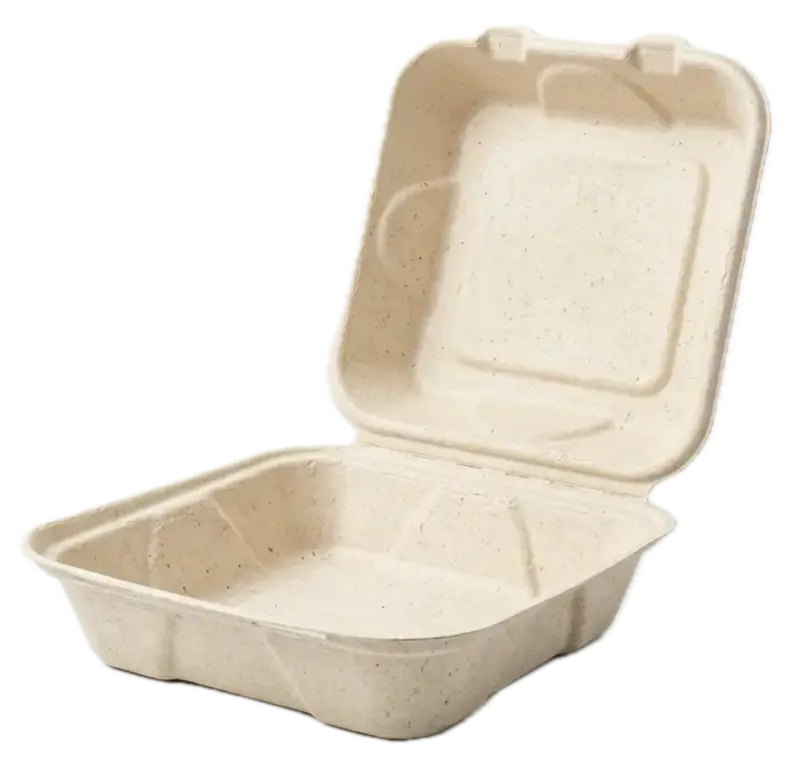 8 x 8 Clamshell Burgers, wraps, salads
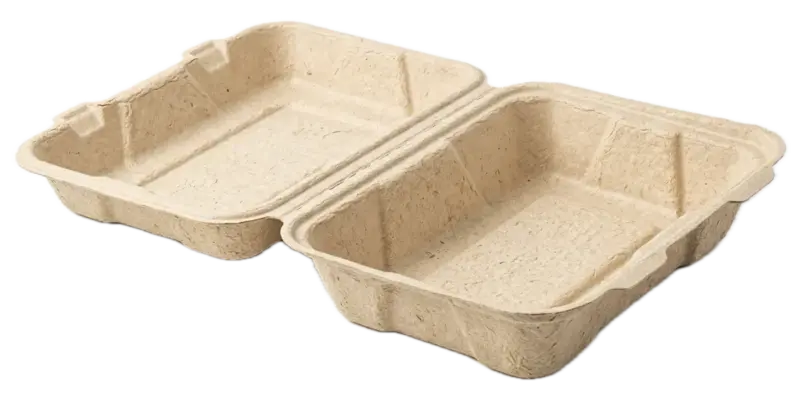 9 x 6 Clamshell Sandwiches, snacks 5 CP Meal Tray + Lid Cloud kitchens, canteens
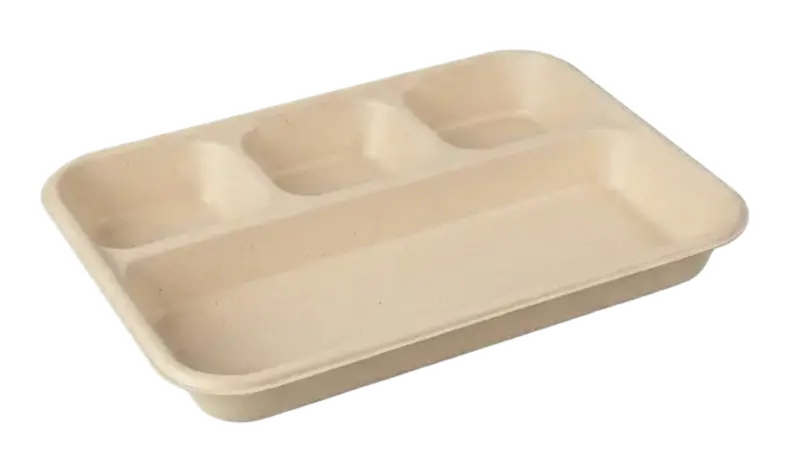 4 CP Meal Tray Dine-in, institutional
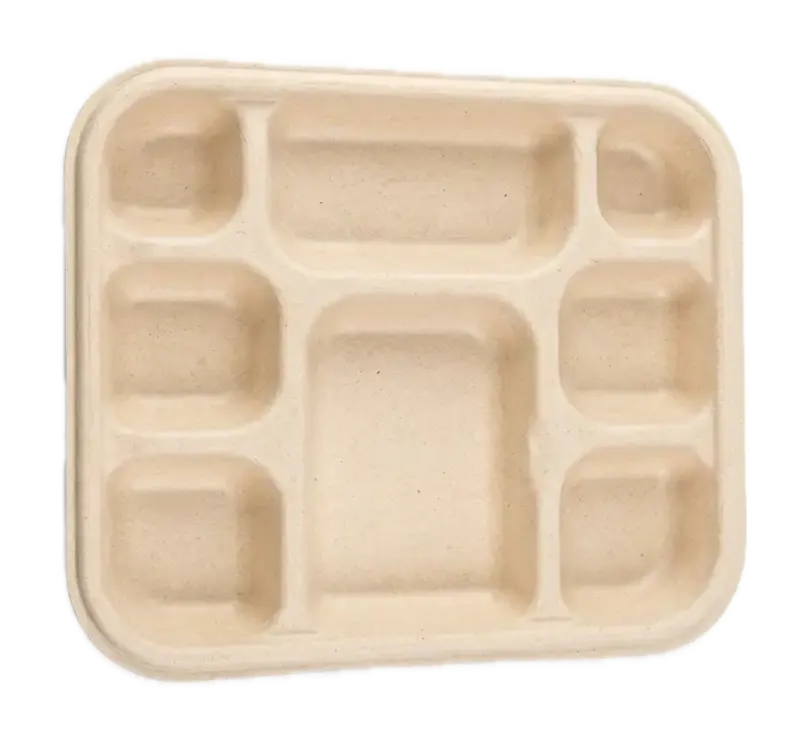 8 CP Meal Tray Thali, buffets, catering
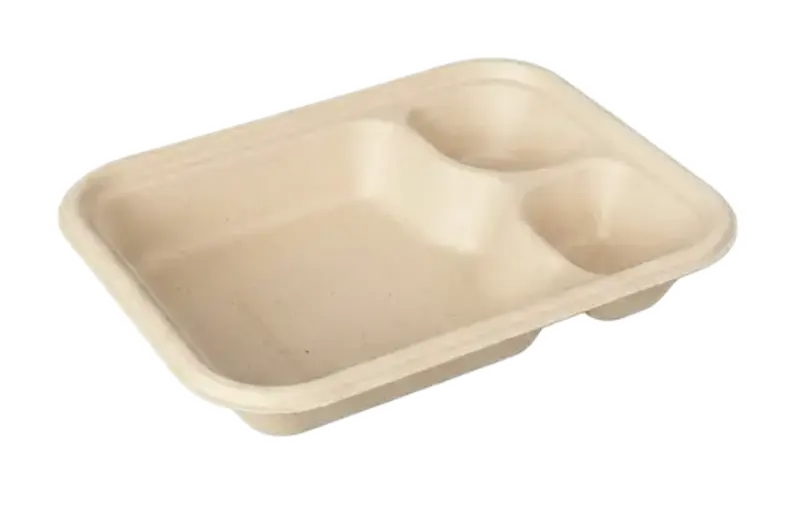 3 CP Snack Tray Events, kiosks
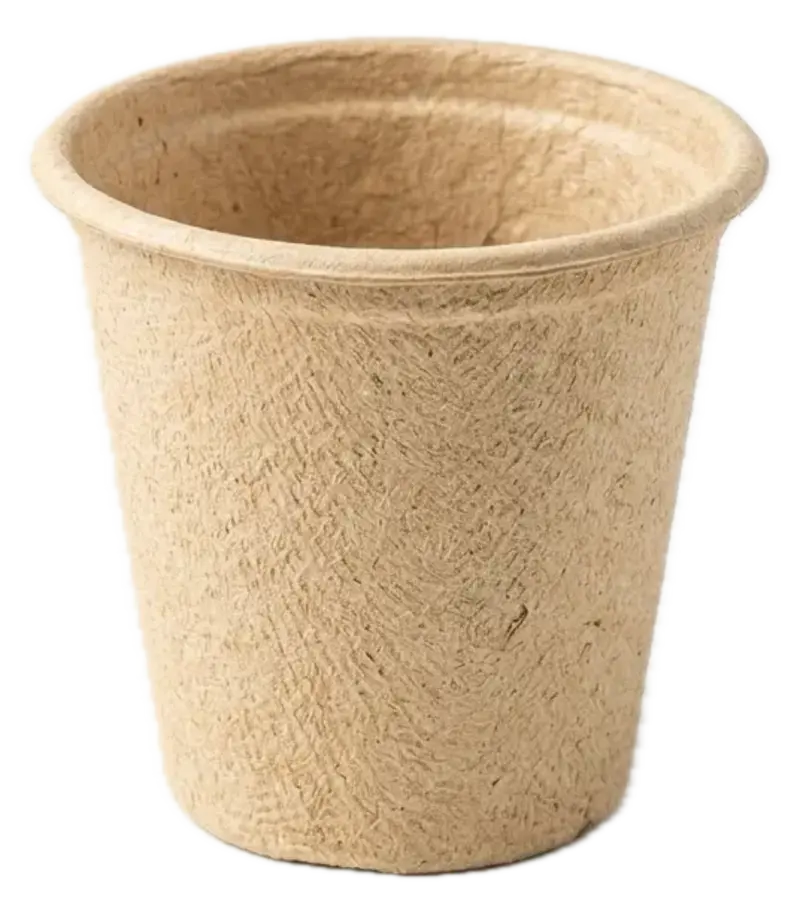 250 ml Cup Hot and cold drinks
The full range also covers dinnerware plates, bowls and oval containers, rectangular and round containers, tamper-proof delivery containers, and matching lids, cutlery and straws.
06The Spec Checklist Before You Order
A good bagasse supplier answers all of these without hesitation. If any answer is vague, ask again before you pay a deposit.
Weight per piece (grams), with a tolerance. This drives strength, oil holdout and price.
PFAS test report per SKU: total fluorine plus targeted PFAS, from an accredited lab.
Heavy metals: lead, cadmium, mercury and hexavalent chromium combined under 100 mg/kg (also a PPWR requirement).
Food-contact compliance for your market: EU Regulation 1935/2004, German LFGB, or US FDA 21 CFR 176.170.
Hot-water and hot-oil holdout: temperature and minutes, for example 95°C water for 30 minutes.
Temperature range: microwave use, freezer use and any oven claim, with time limits.
Compostability certificate held by the manufacturer, not just a logo on the carton.
Packing: pieces per sleeve, sleeves per carton, carton size in cm and gross weight.
Certifications That Matter (and What They Prove)
Certificate / standard
Market
What it proves
EN 13432
EU, UK
Industrially compostable: breaks down within a set time in commercial composting
TÜV Austria OK compost HOME
EU, UK, Australia
Breaks down in a home compost heap at lower temperatures
ASTM D6400 / D6868
USA, Canada
Compostable in commercial facilities; the basis for BPI certification
BPI certified
USA, Canada
Independent compostability certification that also requires no intentionally added PFAS
EU 1935/2004, LFGB
EU, Germany
Safe for food contact; migration tests passed
FDA 21 CFR 176.170
USA
Paper and paperboard components safe for contact with aqueous and fatty foods
Buyer tip
Check the certificate holder's name and the product list on the certifier's online database. Certificates are issued to a manufacturer for named products. A trader's logo on someone else's certificate is a red flag.
Want the PFAS, food-contact and compostability test reports before you decide? We share them for every SKU you are quoting.
Request Test ReportsWhere Bagasse Tableware Works Best
Quick-service restaurants and cloud kitchens use clamshells and lidded meal trays for delivery. Institutional caterers, schools and corporate canteens use compartment trays because one tray replaces a plate and three bowls. Airlines and rail caterers like the rigidity and microwave tolerance. Event and wedding caterers use plates and bowls in volume. Supermarkets and garden centres sell retail packs of 25 or 50 to households replacing plastic and foam.
09What Drives the Price of Bagasse Tableware
Bagasse prices are set mainly by how much fibre goes into each piece and by how complex the mould is. What pushes the price up: heavier pieces, deeper or multi-compartment moulds, snap-fit lids, PFAS-free oil-resistance treatments, embossed or printed logos, retail packaging and small mixed orders. What brings it down: full containers of a few standard SKUs, standard export packing and flexibility on colour.
Our honest advice is the same for every packaging product: compare quotes per piece at the same weight and spec. A clamshell that is 15% lighter than declared will look cheaper on the quote and cost you more in complaints. Weigh ten samples from each supplier before you compare prices.
10How Much Fits in a Container?
Bagasse is light and bulky, so a container is full by volume long before it reaches its weight limit. Carton size, not product weight, decides how much you ship. Here is a worked example for a 40 ft high cube using a typical clamshell carton:
Item
Example value
Carton size
49 x 40 x 26.5 cm = 0.052 CBM
Pieces per carton
200 (4 sleeves of 50)
Cartons per 40 ft HC
about 1,300
Pieces per container
about 260,000
Volume used
about 67.5 CBM
Gross weight (at 40 g per piece)
about 11 MT
Two lessons follow from this. First, a 40 ft high cube almost always beats two 20 ft containers on freight cost per piece. Second, mixing SKUs works well: lids and flat plates nest tightly and fill gaps around bulky clamshell cartons. We confirm the exact count from measured cartons before booking.
11Importing Bagasse Tableware from India
HS code. Bagasse tableware is classified under HS 4823.70, moulded or pressed articles of paper pulp. The US splits it into 4823.70.0020 for plates, bowls and cups and 4823.70.0040 for other items such as clamshells. Indian exporters normally declare under 4823 70 90. Confirm the 8-digit code with your customs broker.
Duties. The US base duty on 4823.70 is free. Since 24 July 2026 most India-origin goods carry an additional 10% Section 301 duty, while Chinese moulded pulp also pays an extra 25% under the older China Section 301 tariffs. For the UK and EU, check the current rate for your exact code. Indian goods benefit from the India-UK trade agreement, and the EU-India agreement is expected to improve terms once it takes effect. Tariffs change often, so confirm with your broker before costing.
Documents. Every shipment should carry a commercial invoice, packing list, certificate of origin, and the PFAS, heavy-metal and food-contact test reports for the SKUs shipped. Keep them in your technical file, because under PPWR the importer is responsible for compliance. Pre-shipment inspection by SGS, Bureau Veritas or Intertek can be arranged.
Get a landed-cost quote for your SKUs, quantities and destination port.
Request a QuoteBagasse Tableware FAQs
Is bagasse tableware PFAS-free?
It can be, but not automatically. Bagasse fibre itself contains no PFAS. Some mills add fluorochemicals for grease resistance. Buy from suppliers who make it without added PFAS and can show a lab test report for each product.
Is bagasse tableware microwave-safe?
Yes. Bagasse plates, bowls and containers are generally microwave-safe for reheating. Check the supplier's stated time and temperature limits, especially for oily food.
How long does bagasse take to compost?
In a commercial composting facility, certified bagasse products typically break down within about 90 to 180 days. Home composting takes longer and depends on conditions.
What is the HS code for bagasse tableware?
HS 4823.70, moulded or pressed articles of paper pulp. In the US, plates, bowls and cups are 4823.70.0020 and other items such as clamshells are 4823.70.0040. India commonly uses 4823 70 90.
What is the difference between bleached and unbleached bagasse?
Unbleached bagasse keeps the natural beige colour of the fibre and skips the bleaching stage. Bleached bagasse is white. Both perform the same; the choice is about appearance and brand image.
Can bagasse containers hold hot, oily food?
Hot liquids, yes. Hot oil is the hardest test for PFAS-free bagasse. Most items handle normal takeaway meals well, but very oily, fried food held for a long time may show marks. Test with your real menu before ordering in volume.
What is the minimum order for bagasse tableware from India?
For export, the usual minimum is one 20 ft or 40 ft container. Several SKUs can be mixed in one container.
Do you provide test reports for bagasse tableware?
Yes. PFAS, food-contact and compostability test reports are available for the SKUs we supply and are shared with your quotation.
Regulatory notes reflect EU Regulation (EU) 2025/40 (PPWR), published US state PFAS laws and US HTS rulings as of October 2026. Tariffs and regulations change; confirm with your customs broker before ordering.