Rice and Wheat Imports from India to Bangladesh : Strategic Grain Corridor
Food security in South Asia relies heavily on cross-border agricultural trade between India and Bangladesh. As Bangladesh’s population exceeds 170 million and dietary consumption patterns diversify, the demand for staple food grains—particularly non-basmati parboiled rice, milling wheat, and derived flour products—remains high.
The trade dynamics between the two nations are entering an active phase. India’s decision to open grain export channels and lift export curbs that were in place since May 2022 provides Bangladesh’s Directorate General of Food (DG Food), private conglomerate millers, and feed manufacturers with a reliable, proximate supplier across land borders and maritime corridors.
1. Trade Context: The 2022–2026 Export Restrictions & The Trade Reset
In May 2022, following intense domestic heatwaves and global grain shocks caused by the Russia–Ukraine conflict, the Government of India imposed a ban on private commercial wheat exports, accompanied by export duties and restrictions on non-basmati white and broken rice.
| Pre-May 2022: | 54%+ of Indian wheat exports went to Bangladesh | | Over 1.15 MMT shipped via rail/road borders. |
|---|---|
| 2022 - 2025: | Commercial bans forced Bangladesh to rely on | | Black Sea / Russian wheat & maritime routes; | | High freight, demurrage, and forex pressure. |
| Policy Pivot: | Export bans lifted; trade resumes via Land | | Customs Stations (LCS) & short-sea routes. |
Impact of the Shift
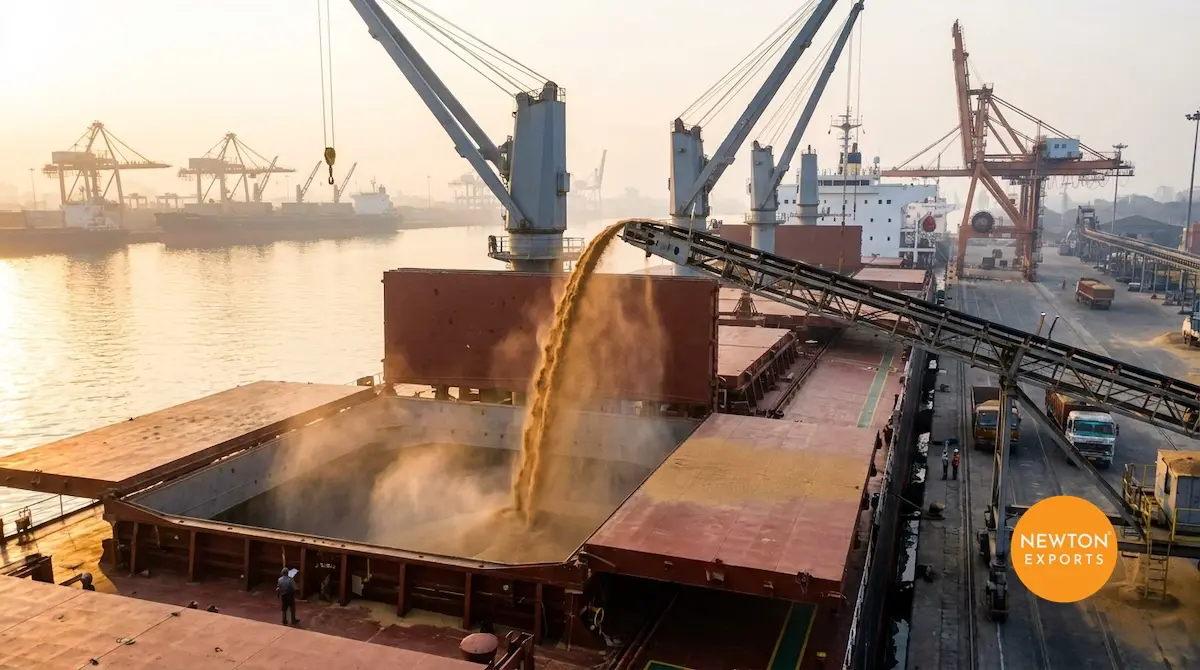
Mitigating Logistics Costs: Sourcing wheat and rice from deep-sea origin ports (Russia, Romania, Ukraine, Canada, or Australia) frequently incurred high ocean freight rates, elevated insurance costs, and vessel congestion delays at Chittagong and Mongla outer anchorages.
Rapid Border Transit: The removal of export barriers allows Bangladeshi buyers to source directly from Indian mills in West Bengal, Andhra Pradesh, Punjab, and Madhya Pradesh, moving consignments across border checkpoints in 2 to 4 days rather than waiting 30 to 45 days for deep-sea bulk vessels.
For comprehensive product offerings across cereals, pulses, and spices, browse our Agri-Food Products catalog.
2. Key Import Channels: Major Port Infrastructure & Transit Hubs
Petrapole–Benapole LCS (Land Port): The primary road corridor connecting West Bengal directly to Jessore and Dhaka. It handles daily 50-tonne truck convoys of parboiled non-basmati rice (Swarna, IR-64, Miniket) with expedited food-grain customs processing.
Gede–Darshana & Singhabad–Rohanpur (Rail Corridors): High-volume bulk freight routes enabling full rakes of Indian milling wheat and coarse rice to transition directly into the Bangladesh Railway network.
Hili & Burimari Land Ports: Strategic northern border crossings facilitating grain transit to Bogura, Rangpur, and Rajshahi divisions.
Chittagong (Chattogram) & Mongla Sea Ports: Main maritime entry points for bulk break-bulk vessels and containerized shipments of specialized grains, industrial semolina, and wheat flour.
For value-added flours, suji, and industrial baking ingredients, view our Wheat Flour, Maida, and Semolina catalog.
3. High-Demand Rice & Wheat Specifications for Bangladeshi Importers
Bangladeshi importers, wholesale stockists, and industrial food groups (such as City Group, Meghna Group, and Bashundhara) assess agricultural commodities using standardized technical parameters:
Rice Quality Specifications (Non-Basmati Parboiled & White Rice)
| Quality Parameter | Parboiled Rice (Swarna / IR-64 / PR-106) | Miniket / Long Grain White Rice |
|---|---|---|
| Broken Grains | 5.0% Max (Standard) / 25.0% Max (Coarse) | 5.0% Max |
| Grain Length (Average) | 5.8 mm – 6.4 mm | 6.5 mm – 7.0 mm |
| Moisture Content | 13.0% – 14.0% Max | 12.5% – 13.0% Max |
| Damaged / Discolored Kernels | Well Milled, Sortex 100% Cleaned | Double Polished / Silky Silo Cleaned |
| Paddy Grains (Foreign Grain) | Nil to 0.2% Max | Nil (<0.1%) |
Milling Wheat Quality Specifications (Triticum aestivum)
| Parameter | DG Food Bangladesh Tender Benchmark | Commercial Roller Flour Mill Standard |
|---|---|---|
| Protein (Dry Basis) | 11.5% – 12.5% Min | 12.0% – 13.5% Min |
| Test Weight (Hectoliter) | 76.0 – 78.0 kg/hl Min | 78.0 – 80.0 kg/hl Min |
| Moisture Content | 12.0% Max | 11.5% – 12.0% Max |
| Foreign Matter (Dockage) | 1.0% Max | 0.50% – 0.75% Max |
| Hagberg Falling Number | 300 – 350 Seconds Min | 350 – 450 Seconds Min |
| Wet Gluten | 24.0% – 26.0% Min | 27.0% – 29.0% Min |
| Karnal Bunt & Mycotoxins | Non-detectable / Zero Tolerance | Phytosanitary Certified Compliant |
Explore our Wheat Catalog here.
4. Why Bangladeshi Importers Benefit from Sourcing Indian Grains
CORE ADVANTAGES FOR BANGLADESH IMPORTERS
| Key Concerns | Advantages |
|---|---|
| Lead Time | 2 to 5 days via border rail/road vs 35+ by sea |
| Working Capital | Smaller, frequent trucks/ rakes lower storage holding |
| Food Habits | Parboiled coarse grains match consumer staple |
| Port Demurrage | Direct rail avoids Chittagong vessel congestion |
Short Transit Windows: Rail rakes dispatched from grain hubs in Haryana, Punjab, or Bihar arrive at Bangladeshi borders within days, allowing importers to respond quickly to domestic price movements.
Lower Working Capital Exposure: Purchasing containerized or rake loads allows private mills to avoid tying up millions of dollars in single capesize/panamax shipments from distant origins.
Optimized Milling Ratios: Indian hard amber bread wheat provides balanced gluten strength and high water absorption (>60%), giving Bangladeshi bakeries and flatbread (roti/paratha) makers higher dough yields per metric tonne of flour.
For additional context on regional supply chains and trade dynamics, you can review this discussion on Bangladesh's wheat sourcing strategy
Looking to import rice or wheat from India to Bangladesh?
Browse Newton Exports’ wheat and flour catalog or get in touch for bulk export pricing and packaging options.